Research
Educational settings such as schools are key institutions in which knowledge related to racism is transmitted and individuals are distinguished on the basis of racist relations of difference . Schools thus play a significant role in the (re-)production of racist conditions. Teacher education is an important setting for the professional development of (prospective) teachers with regard to their practice in schools. However, gaps in addressing racism are repeatedly identified within this context.
The junior/early-career research group addresses these gaps from both empirical and conceptual perspectives and examines, through the lens of Critical Race Theory, the three phases of teacher education: studies, teaching training, and career entry.
Research goals
Conditions
The reconstruction, analysis, and theorization of conditions that tend to enable the success of racism-sensitive teacher education
Experiences
Identification of mechanisms of exclusion affecting teachers who potentially experience racism
Pedagogical/Educational professionalism
Establishment of racism-sensitive perspectives on pedagogical professionalism
Educational research on racism
Institutionalisation and professionalisation of educational science research on racism with a focus on teacher education.
Research design
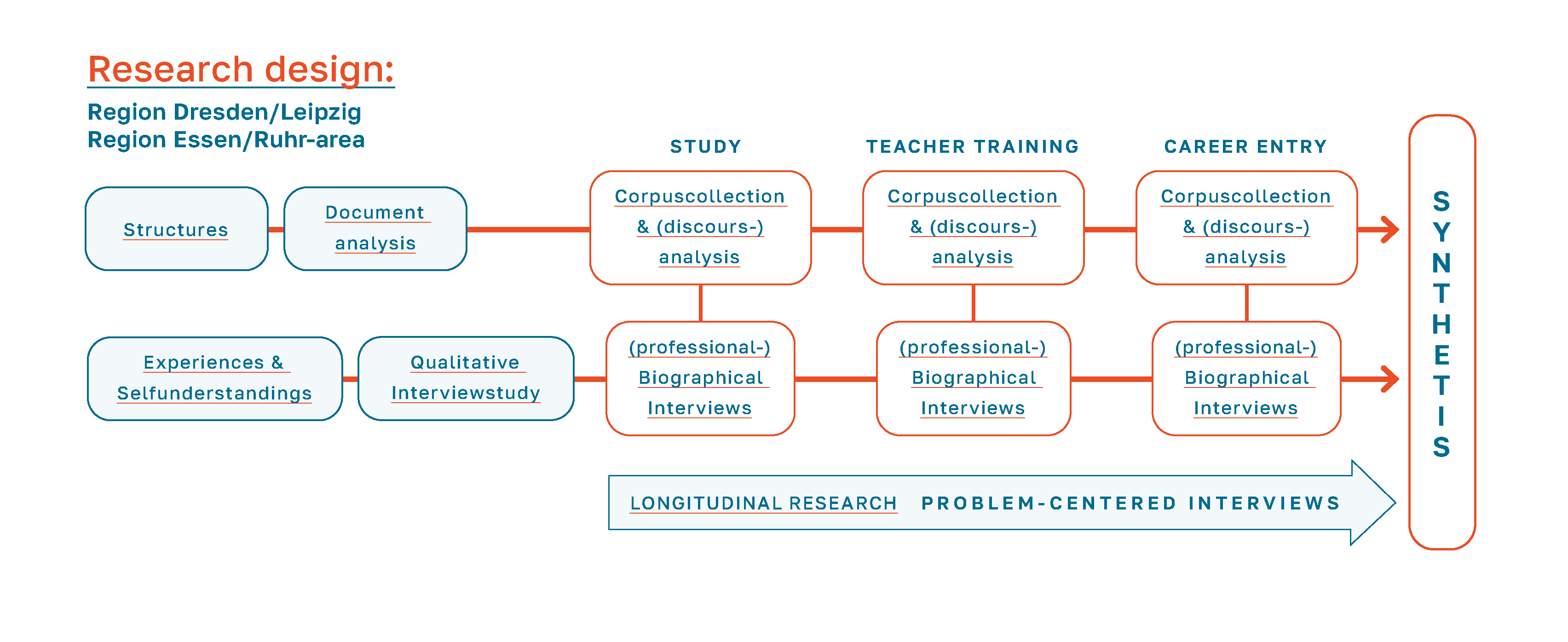
The junior research group is conducting a fundamental theoretical study of racism in the three phases of teacher education, focusing on racism-related structures and moments in teacher education. The structural conditions are reconstructed through a discourse-analytic document analysis. To reconstruct the experiences and professional self-conceptions of (prospective) teachers, career-biographical and problem-centered interviews will be conducted in all three phases at two research locations. The study employs a longitudinal design, which means that some of the students interviewed at the beginning will also be followed during their teaching training and early career.
Methodological and theoretical perspectives
This study builds on theoretical perspectives on racism that understand racism as a fundamental social relationship of difference in which people are categorized into national-ethno-cultural groups. From this perspective, forms of racism are potentially present in all areas of social life and operate largely implicitly and subtly,meaning that it is not possible to be entirely “outside” of racism. For GraL, the keytheoretical and methodological approaches are:
Critical Race Theory in Teacher Education (CRT)
The CRT approach is characterised by a contextualising and historicising analysis. It recognises and incorporates the experiential knowledge of people of color (BIPoC). Originating in the US and UK context, the approach is adapted and further developedwithin GraL in a context-sensitive manner.
Critical Educational Science on Migration
Theoretical and methodological approaches from critical educational science on migration draw on cultural studies approaches to the exploration of educational conditions through the lens of racism theory.
Methodological design